

ARTICLE
As a Green Foreign Policy Fellow of the Heinrich Böll Foundation Thessaloniki in 2025–2026, Francesca Fassbender aims to explore how post‑war recovery can be reimagined through the lens of the green foreign & security policy narrative. She examines whether reconstruction is ever neutral and asks what recovery could become when equity, sustainabilty, and participation ground decisions from the outset.

The 21st-century global order is increasingly shaped by polycrisis, in which security, governance and environmental breakdowns intersect and reinforce one another. War exposes this entanglement most starkly: armed conflict disrupts not only lives, but also the institutions, infrastructures and ecosystems that sustain everyday stability. Post-war recovery is therefore not merely a development task, but a foreign-policy challenge that shapes civilian livelihoods, who is protected, which rights are upheld, and whether future vulnerabilities are eased or deepened. It is also a question of ecological resilience, as the destruction of biodiversity, land and water systems can become a long-term and often irreversible legacy of war[1].
Recent wars in Gaza, Ukraine, Sudan, Syria and Yemen illustrate this pattern. Conflict systematically degrades housing, health and education systems, as well as energy grids, water and sanitation networks, agriculture and waste management. In Gaza, infrastructure and ecosystems have faced unprecedented strain; in Ukraine, energy grids and dams have become strategic targets; in Sudan and Yemen, damage to rural livelihoods and water systems has contributed to cascading hunger and public-health crises.[2]
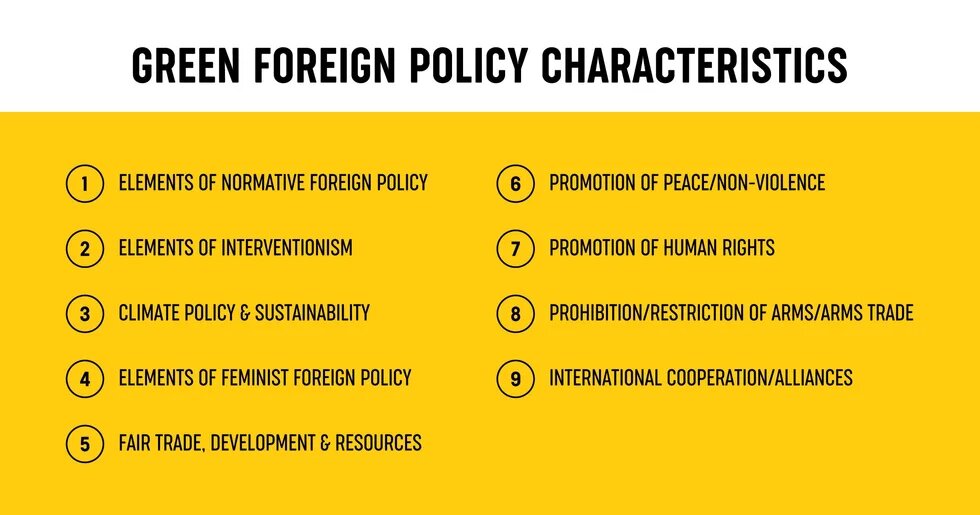
The Green Foreign Policy Snapshots published in 2023 by the Heinrich Böll Foundation Thessaloniki Office codify the Green Foreign and Security Policy (GFSP) narrative as a value-driven approach to foreign & security policy. Across countries, Green parties converge on a profile that combines rules-based multilateralism, principled intervention, strong climate and environmental commitments, elements of feminist foreign policy and human rights, limits on militarisation, and an emphasis on fair trade, resource justice, peace, non-violence and participatory decision-making.[3]
Building on this framework, this article argues that post-war recovery remains a central yet consistently under-studied arena of the GFSP narrative. Post-war recovery is understood here as the medium- to long-term process through which societies emerging from large-scale violence restore and transform institutions, infrastructure, ecosystems and livelihoods. Given the breadth of the recovery agenda, and because environmental rehabilitation is often treated as secondary, this fellowship project will focus more deeply on the recovery of the environment and environmental infrastructure, while not examining this dimension in isolation. The fellowship draws on this space to explore how the elements codified in the 2023 work of Heinrich Böll Stiftung can guide more concrete reconstruction choices; without assuming that recovery is only about rebuilding what was, but also about deciding what comes next, and who is included in shaping it.
The guiding question is therefore: What would post-war recovery look like if Green and Feminist Foreign Policy principles guided decisions from the outset? The project advances three contributions: positioning recovery as a key field of GFSP, connecting research on gender, environment and post-conflict recovery to policy debates, and developing practical tools for policymakers.
Gaza serves as the central empirical case. The recent war has produced massive infrastructural and ecological destruction while triggering a political debate on Gaza’s “day after.” This makes it a crucial setting in which to examine whether reconstruction can advance Palestinian ownership and participation, transitional justice and environmental repair rather than treating GFSP principles as secondary add-ons. This article marks the first public output of the fellowship and seeks to open a broader conversation on operationalising GFSP in post-war recovery.
The normative “DNA”: three research traditions
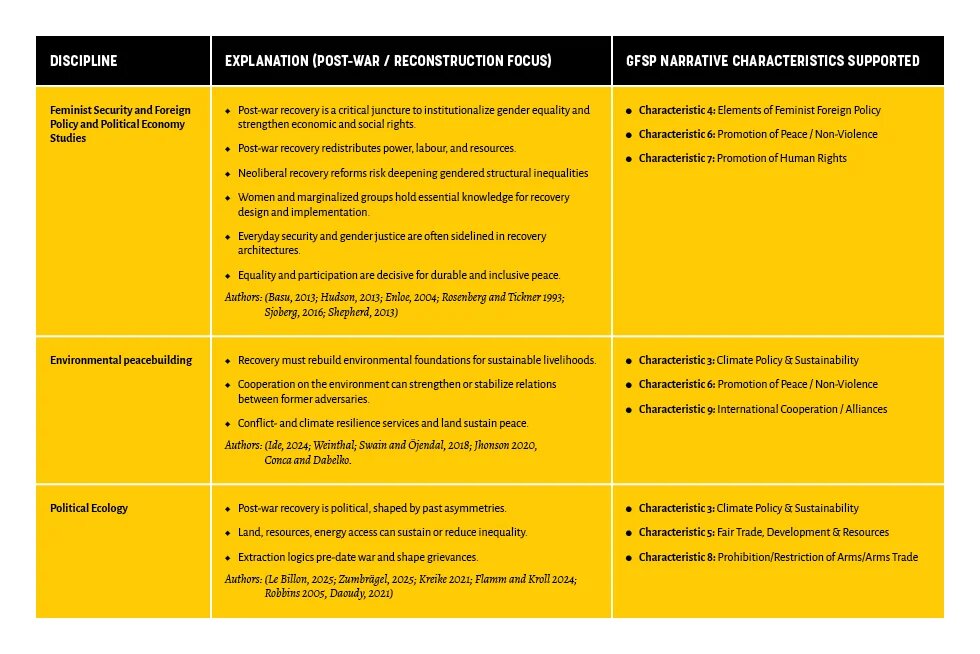
The Green Foreign Policy Snapshots[4] codifies nine interlinked characteristics that define a transformative foreign policy framework. Yet, these principles remain largely normative, powerful in vision but thin in operational depth. The study argues that the theoretical foundations needed to make the GFSP narrative actionable already exist within at least three academic traditions:
This fellowship treats these three bodies of work as the normative and analytical DNA of the GFSP narrative in post-war settings and will bring them into systematic conversation with ongoing recovery debates. Drawing on Flamm and Kroll’s (2024) integration of political ecology and environmental peacebuilding in the context of Russia’s war against Ukraine, this project extends their framework to additional post-war settings and incorporates insights from feminist studies into post-war recovery.
From conceptual DNA to political reality
Building on this normative and analytical foundation, the next step is to examine how these principles operate under real-world political constraints. Post-war recovery unfolds within existing power structures, security arrangements and capital flows. To assess whether and how GFSP commitments can be operationalised, an empirical perspective is required.
Gaza’s post-war recovery debate is unfolding against the background of extreme destruction. Following the October 7, 2023 attacks by Hamas on Israel, Israel launched a large-scale military campaign in Gaza that resulted in the widespread destruction of housing and critical infrastructure. Although a ceasefire has been in place since late 2025 the humanitarian and environmental consequences of the war remain devastating. UN agencies report more than 70 thousands Palestinians killed and many more injured, a large majority estimated to be civilians, repeated mass displacement, and the collapse of basic service systems, including water, sanitation, and wastewater. Sewage, solid waste, and toxic residues contaminate soil, groundwater, and the coastline. The scale of destruction also includes debris burdens of 60–61 million tones and near-total inaccessibility of cropland and agricultural infrastructure.[5]
The large-scale physical destruction in Gaza and the subsequent ceasefire have shifted the policy focus from active hostilities to the institutional design of post-war recovery. Since November 2025, the primary formal framework has been the U.S.-drafted 20-point plan, endorsed by UN Security Council Resolution 2803. This resolution establishes a new governance architecture for the “day after” in Gaza. At the centre of this architecture is the Board of Peace (BoP), which is mandated to define strategic priorities and coordinate and oversee international funding for Gaza’s reconstruction and redevelopment. In parallel, an International Stabilisation Force has been authorised to support border management, facilitate demilitarisation measures, and provide basic security guarantees during the transitional phase. To manage civilian governance functions, a technocratic Palestinian National Committee for the Administration of Gaza (NCAG) has been created. The NCAG is tasked with overseeing day-to-day administrative affairs, operating under international supervision and within the broader strategic parameters set by the BoP and associated international actors.[6]
However, the composition and mandate of the BoP have generated considerable controversy. The Board’s Charter vests extensive executive authority in its Chair, U.S. President Donald Trump. Permanent membership is tied to billion-dollar financial contributions, effectively institutionalising a pay-to-participate model that privileges major donor states. While Israel holds a seat within the Board structure, Palestinian representation is confined to the NCAG.[7]
The architecture prioritises disarmament, border management and stabilisation as technical preconditions for reconstruction, with financial coordination structured around major donor contributions. Environmental rehabilitation, land governance, human security, gender equality and transitional justice are not embedded as core pillars of the mandate. This sequencing risks sidelining the historical power asymmetries and territorial dependencies.[8]
The Davos inauguration of the BoP in January 2026 crystallised this tension. At the World Economic Forum, Jared Kushner presented a 30-billion-dollar vision for “New Gaza,” featuring high-rise towers, investment zones and a redesigned coastal skyline, and framed it primarily as a large-scale investment opportunity.[9]
The polished visualisations stood in stark contrast to the prevailing realities of destruction, displacement and infrastructural collapse. In this framing, reconstruction appeared less as a process of social and ecological recovery and more as a capital-intensive redevelopment project driven by external investment priorities rather than by Palestinian ownership and participation.
It is therefore unsurprising that actors aligned with Green or Feminist Foreign Policy frameworks remain marginal within the current institutional design. In this context, Gaza becomes a critical case for the Green Foreign and Security Policy (GFSP) narrative: a setting where environmental degradation, occupation and regional power competition intersect. This project seeks to translate GFSP commitments into concrete, context-sensitive recommendations that are intelligible to the governments, donors and regional actors shaping Gaza’s recovery (Heinrich Böll Stiftung – Thessaloniki Office, 2023). Doing so requires examining how these principles can be advanced within, around or in parallel to the existing Board of Peace architecture.
I welcome exchanges with those working on Gaza’s recovery, post-conflict reconstruction, or feminist, environmental and justice-oriented foreign policy.
[1] Lina Rist, Albert Norström, and Carina Queiroz, “Biodiversity, Peace and Conflict: Understanding the Connections,” Current Opinion in Environmental Sustainability 68 (2024): 101431, https://doi.org/10.1016/j.cosust.2024.101431;
Sultan Barakat and Steven A. Zyck, “The Evolution of Post-Conflict Recovery,” Third World Quarterly 30, no. 6 (2009): 1069–1086, https://doi.org/10.1080/01436590903037333.
[2] CFR. 2022. “Conflict in Yemen and the Red Sea | Global Conflict Tracker.” Global Conflict Tracker. 2022. https://www.cfr.org/global-conflict-tracker/conflict/war-yemen;
Flamm, Patrick, and Stefan Kroll. 2024. “Environmental (in)security, peacebuilding and green economic recovery in the context of Russia’s war against Ukraine.” Environment and Security 2 (1): 21–46. https://doi.org/10.1177/27538796241231332;
UNICEF. 2025. Ein Baby im Sudan wird gegen Infektionskrankheiten geimpft | © UNICEF/Abdulmajid. Deutsches Komitee Für UNICEF e.V. https://www.unicef.de/informieren/projekte/afrika-2244/sudan-195518/gew….
[3] Astyrakakis Aslanis, Evangelos. 2023. “Green Foreign Policy Snapshots | Heinrich Böll Stiftung - Thessaloniki Office.” Heinrich Böll Stiftung - Thessaloniki Office. September 13, 2023. https://gr.boell.org/en/2023/09/13/green-foreign-policy-snapshots.
[4] Astyrakakis Aslanis, “Green Foreign Policy Snapshots.” Shepherd, Laura J. 2013. “The State of Feminist Security Studies: Continuing the Conversation.” International Studies Perspectives 14 (4): 436–39. https://doi.org/10.1111/insp.12055.
Sjoberg, Laura. 2016. “What, and Where, Is Feminist Security Studies?” Journal of Regional Security 11 (2): 143–61. https://doi.org/10.11643/issn.2217-995x162sps66.
[5] UNDP. 2025. “Clearing most of the rubble in the Gaza Strip is possible in seven years under right conditions.”;
FAO. 2025. “Gaza Strip: 98.5 percent of cropland unavailable for cultivation as famine looms.”;
Hall, N., and R. Mellen. 2025. “Israel Has Bombed Much of Gaza to the Rubble. What Would It Take to Rebuild?” Washington Post, 2025. https://www.washingtonpost.com/world/interactive/2024/gaza-reconstructi….
[6]The White House. 2026. “President Trump Ratifies Board of Peace in Historic Ceremony, Opening Path to Hope and Dignity for Gazans.” January 22, 2026. https://www.whitehouse.gov/articles/2026/01/president-trump-ratifies-board-of-peace-in-historic-ceremony-opening-path-to-hope-and-dignity-for-gazans/;
Lovatt, H. 2026. “Welcome to the Jungle: Trump’s Board of Peace Goes Global.” ECFR. January 26, 2026. https://ecfr.eu/article/welcome-to-the-jungle-trumps-board-of-peace-goe….
[7] Ibid.
[8]Dunne, Charles W. 2026. “Trump’s Board of Peace: Rebuilding Gaza, or Remaking the World?” Arab Center Washington DC. February 18, 2026. https://arabcenterdc.org/resource/trumps-board-of-peace-rebuilding-gaza….
[9]Alter, E. 2026. “The Promise and Peril of Trump’s Board of Peace - Atlantic Council.” Atlantic Council. February 16, 2026. https://www.atlanticcouncil.org/dispatches/the-promise-and-peril-of-tru….